
The Nanostructured Functional Materials Group is developing new materials for window coatings that can dynamically regulate the amount of light and heat entering buildings. In their latest publications, the group has explored different synergistic combinations of photochromic, thermochromic, and electrochromic hybrid materials to better control solar radiation and improve indoor thermal comfort.

Smart windows are increasingly being considered a valuable tool for improving the energy efficiency of buildings. These technologies can regulate factors such as solar heat and light transmission in response to changing environmental conditions. They are also one of the main research areas of the ICN2 Nanostructured Functional Materials Group (Nanosfun), led by CSIC Prof. Daniel Ruiz-Molina. Under the leadership of Dr Claudio Roscini, and in collaboration with the UAB and other foreign universities, the group is investigating various materials whose optical properties change in response to factors such as light, temperature variations or electricity. The aim is to develop technologies that can improve the management of solar radiation and thermal conditions inside buildings.
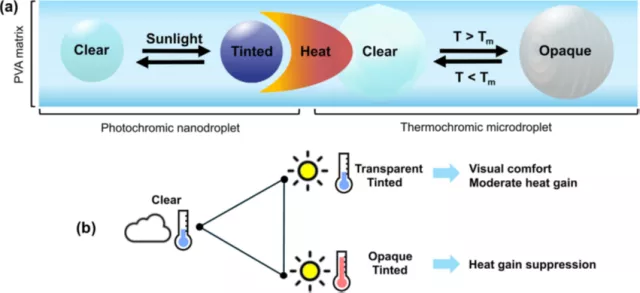
One of the group’s latest approaches, published in Advanced Functional Materials, synergistically combines photochromism and thermochromism in a single window. The system uses photochromic dyes confined in tiny liquid nanodroplets, an advanced technology previously developed with ICN2 spinoff company Futurechromes SL and that ensures fast response. When exposed to sunlight, these materials darken and convert part of the incoming visible radiation into heat. This heat then activates a second paraffin-based layer, which scatters light and gradually makes the window more opaque as solar radiation increases. The result is a film that can transition between different optical states depending on its surroundings: it can remain transparent in low light, darken as solar radiation increases, and become more opaque and dark when simultaneously light intensity and temperature are relatively high. In a model house, the system reduced the increase in indoor temperature by up to 41%.
Furthermore, the group's research explored the combination of similar photothermochromic materials in a crosslinked polymer matrix to give the film water resistance. This makes it better suited to changing weather conditions and closer to practical applications.
These studies were carried out in collaboration with researchers from the Universitat Autònoma de Barcelona (UAB), led by Prof. Jordi Hernando, as well as Futurechromes, a spin-off from ICN2 specialising in this type of technology. At ICN2, Dr Lorenzo Vallan led the experimental work, under the supervision of Dr Roscini.
Achieving electrical control in windows at lower voltage
Another approach the group developed is based on electro-thermochromic windows, which combine a thermal response with electrical control. In this case, the window contains an electrochromic layer that darkens when a low voltage is applied to it. This layer absorbs solar radiation and converts it into heat, which activates a second thermochromic layer. As with the previous approach, this combination lets the window adopt different optical states and regulate how much light passes through. However, the added electrical control gives users greater control over when the window changes state while requiring only a small amount of electrical energy.
In this research, published in Advanced Science, the team also collaborated with researchers from Donghua University in Shanghai, China, in addition to the UAB team.
These advances reflect the same research direction: developing dynamic glazing that can respond to solar radiation and environmental conditions to help improve indoor comfort and reduce unwanted solar heat gain. The collaboration between ICN2, UAB and Futurechromes brings together the various stages of the process, from materials and device design to prototyping and technology transfer.
Reference articles:
Vallan, L.; Carrascull-Marín, A.; Wu, X.; Ruiz-Molina, D.; Hernando, J.; Roscini, C. Self-Adjusting Photothermal Heating for Multi-State Photo-Thermochromic Glazing. Advanced Functional Materials. (2026). DOI: 10.1002/adfm.78530.
Villabona, M.; Vallan, L.; Ruiz-Molina, D.; Roscini, C.; Hernando, J. Weather-Resistant Thermoresponsive UV-Curable Smart Window Composites Based on Paraffin Particles. ACS Applied Materials & Interfaces. (2026). DOI: 10.1021/acsami.6c04877
Wu, X.; Vallan, L.; Li, H.; Ramon Otaegui, J.; Mena, S.; Jiang, W.; Wang, H.; Barnes, J. C.; Ruiz-Molina, D.; Li, K.; Hernando, J.; Roscini, C.; Guirado, G. Synergistic Effects in Multistate Black Electro-Thermochromic Smart Windows for Energy-Efficient Modulation of Solar Heating. Advanced Science. (2026). DOI: 10.1002/advs.77765.
Notícies relacionades
Veure'n mésTowards a new generation of photoprotecting smart windows that respond to light and heat

ICN2 hosts AI4SCITECH, a two-day event exploring AI applications in science and industry

In situ spectroscopy and microscopy reveal new insights into electrocatalytic nitrate reduction
