

ICN2 researchers have contributed to a study showing that manganese telluride (MnTe) changes its magnetic behaviour when reduced to atomically thin layers, revealing unprecedented properties in the 2D realm. These findings could play a key role in the development of next-generation spintronics.
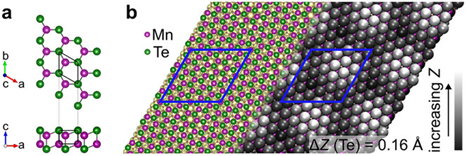
Manganese telluride (MnTe) is one of the most representative materials among the so-called altermagnets. These materials are particularly interesting because they combine properties of ferromagnetic and antiferromagnetic materials: in ferromagnets, the energy levels of electrons with opposite spins are well separated, resulting in spins aligning in the same direction and generating a net magnetic field. Whereas in antiferromagnets, spins are oriented antiparallel and cancel each other out, resulting in no overall magnetisation. Altermagnets occupy an intermediate position: they break spin-degeneracy like ferromagnets, yet do not produce a net magnetic field, like antiferromagnets. Such unique combination makes them highly promising for the development of more rapid and efficient spintronic technologies.
A new study published in Advanced Functional Materials, conducted by researchers from IMDEA Nanociencia, ICN2, Materials Physics Center (CSIC – EHU) and ALBA Synchrotron, investigated whether the altermagnetic properties persist when the material is reduced to layers just one or two atoms thick. The researchers, led by Dr Marc González Cuxart (ICN2 Atomic Manipulation and Spectroscopy Group), grew these MnTe layers on a graphene substrate and examined their structure and magnetism using a correlative approach that included scanning probe microscopy (SPM), synchrotron-based X-ray magnetic circular dichroism, and theoretical calculations.
The results showed that when MnTe is thinned to the atomic limit, its structural symmetry changes, and altermagnetism disappears. Instead, unexpected magnetic behaviours emerge. In the case of the monolayer, the magnetic moments freeze into a disordered magnetic system compatible with a spin glass, something never observed before in a material this thin. In contrast, the bilayer develops a more stable antiferromagnetic order, resistant to extremely strong magnetic fields.
These findings demonstrate how reducing a material’s dimensionality can completely transform its magnetic properties and open the door to new approaches for studying quantum magnetism and developing more efficient spintronic devices based on ultrathin materials.
Reference article:
Cuxart, M.G; Robles, R; Muñiz Cano, B; Gargiani, P; Rebanal, C; Di Bernardo, I; Amiri, A; Calleja, F; Garnica, M; Valbuena, M.A; Vázquez de Parga, A.L. (2025). Emergent Magnetic Structures at the 2D Limit of the Altermagnet MnTe. Advanced Functional Materials. (2025). https://doi.org/10.1002/adfm.202516924