

By completing a project to implement a FAIR scientific data management system, the institute has transformed its data infrastructure, enabling the automated integration and standardised publication of experimental datasets alongside traditional scientific outputs.

ICN2 has completed the main technical execution of project MDG-23-11382, funded by the María de Guzmán call of the Spanish Foundation for Science and Technology (FECYT) and the Ministry of Science and Innovation. With a budget of 85,000 euros over 23 months (2024-2025), the initiative has fully aligned the iMarina Current Research Information System (CRIS) with the FAIR principles (Findable, Accessible, Interoperable, Reusable).
This project is a direct and concrete contribution to the pioneering National Open Science Strategy 2023-2027, a framework in whose definition the ICN2 played a leading role through the representation of Núria Benítez in the SOMMA alliance."This project consolidated ICN2 engagement in Open Science as a pioneering center in FAIR data management at the national level, and we aim to continue our engagement and have strong leadership at the European level", adds Laura María Florez, Coordinator of Project MDG-23-11382.
The results are structured around four strategic pillars, with quantifiable outcomes:
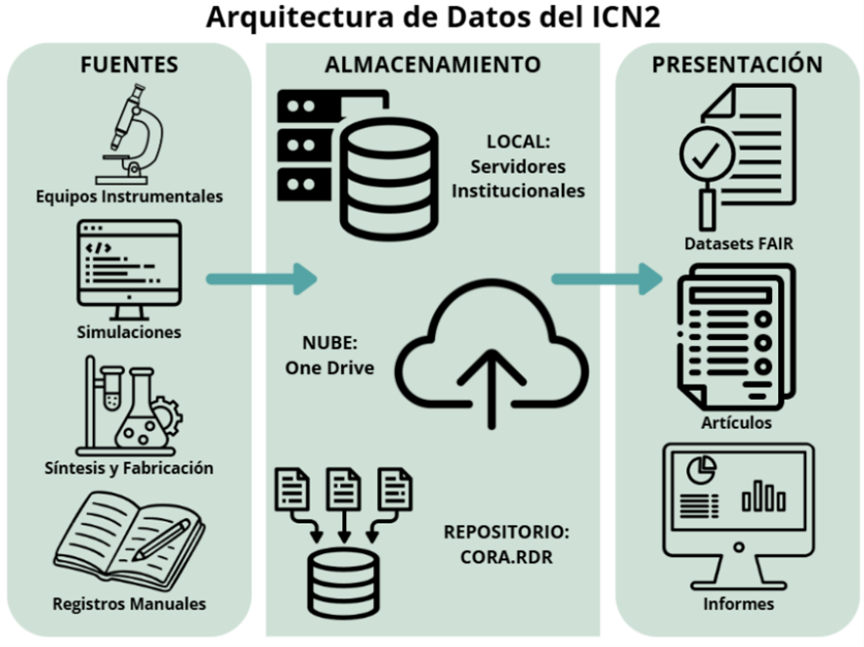
- ICN2 has enhanced its data infrastructure by adding 500 TB of storage in disk arrays. Moreover, nine of the centre’s research groups have defined their data architectures, and each group includes at least one person specifically trained in FAIR principles and data management.
- The team implemented a four-phase operational methodology—planning, organisation, description, and publication. This approach led to the publication of eight datasets in the CORA.RDR repository, with six more currently in draft stage. All datasets carry Digital Object Identifiers (DOIs), and the system integrates them automatically and weekly into the iMarina CRIS via an API.
- Following an analysis of 28,478 terms extracted from ICN2 publications (2015–2025), the team compiled a controlled vocabulary comprising 200 key terms.
- The platform now has a new iPublic space based on the INVENIO semantic engine, the capability to download reports directly from public listings, and connectors with external sources such as the EU's CORDIS and Data Management Plans (DMPs). This substantially improves the visibility and traceability of scientific outputs.
The institutional impact is transformative: ICN2 has established the technological and human foundations to operate within the European open science ecosystem. The ability to manage, publish, and link research data alongside traditional publications in a single system positions the center at the forefront of scientific transparency and knowledge reuse. "This project marks a turning point for ICN2. Besides laying the foundations for Open Data, it has also empowered a strong team to lead an innovative path toward a truly open science", highlights Margarita Navia, Head of Strategy Development at ICN2.
The MDG project strengthened our Open Science team to lead and participate in other high-impact meetings. These include hosting the 2024 of Spanish Severo Ochoa and María de Maeztu excellence centres (SOMMa) Open Science Working Group meeting in Barcelona, where we presented ICN2's open science policy roadmap.
ICN2 actively participated at the IRTA Open Science conference ("Open Science in action: challenges and opportunities" FECYT) in Caldes de Montbui, and the FAIR Data Fair in Barcelona (2024 at UPF & 2025 at UOC), engaging with the Catalan research community on data policies. Additionally, we joined the UAB Open Science Day at the Autonomous University of Barcelona, learning about innovative assessment tools and institutional open science commitments.
The infrastructure and expertise developed through the MDG allowed us to submit a strong application to the Catalan Open Science Awards (CSUC), competing effectively with other local research centres. Finally, we organised a training in Open Science communication to enhance scientific dissemination.
"The María de Guzmán grant has been the catalyst to optimise and connect our information systems. We now have a robust workflow that, from the acquisition to the publication of a dataset in CORA.RDR, is in process of complying with the highest standards of interoperability", emphasises ICN2 Data Steward, Jan Rodriguez.