

Wednesday, 01 April 2026
ICN2 Announces the Projects Selected in the Severo Ochoa Seed Funding Call “NanoSolutions in Oncology”
PHARO and BioSeal, led by Dr Maria Soler and Dr Salvio Suárez respectively, have been awarded funding in this call and will advance innovative nanotechnology-based solutions for medical applications through close collaboration with leading clinical institutions.
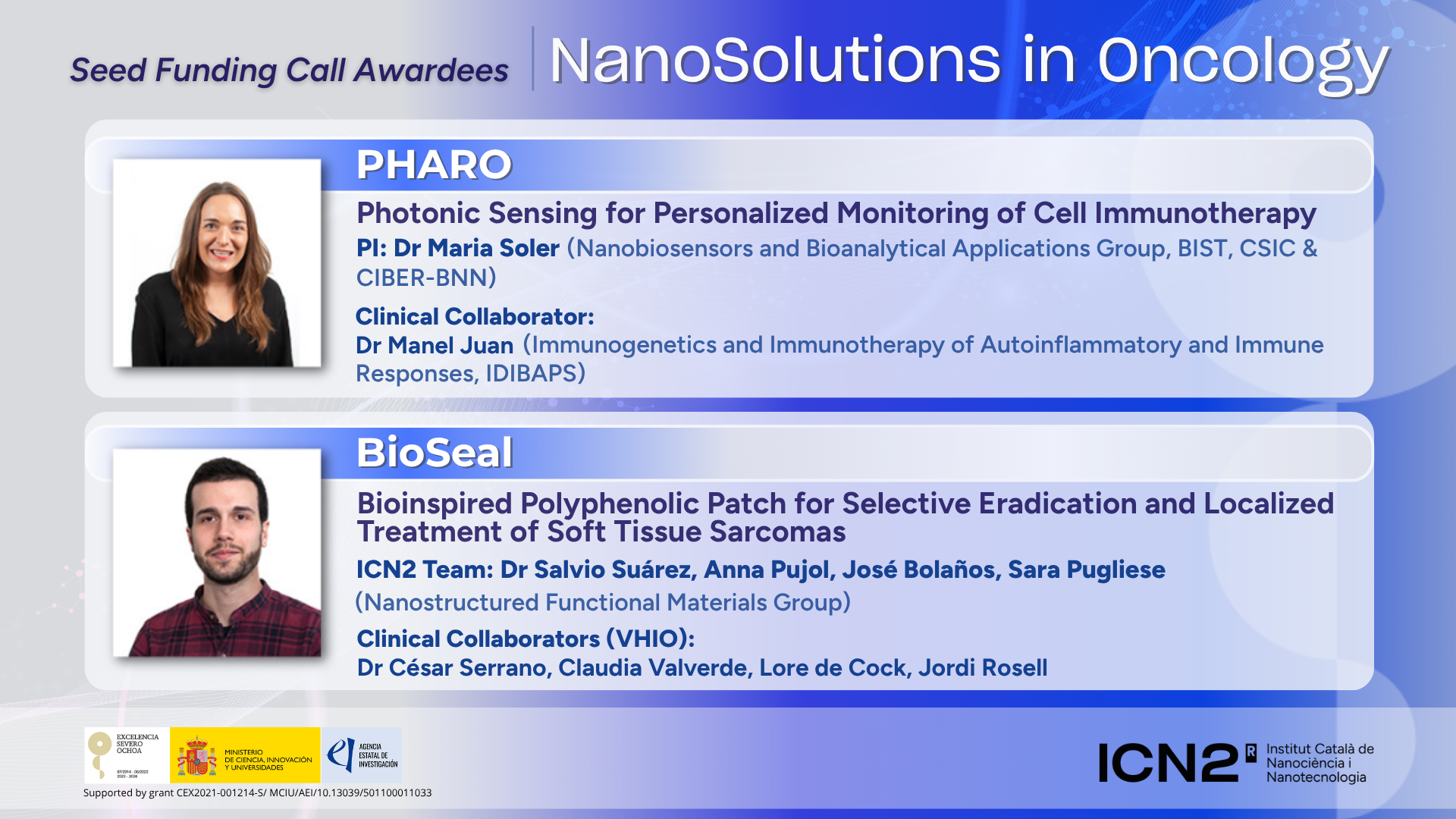
ICN2 has concluded the first edition of the Severo Ochoa Seed Funding Call: NanoSolutions in Oncology, an initiative created to boost translational research in nanomedicine and strengthen ICN2’s strategic collaboration with hospitals and clinical teams in the field of oncology.
This call aligns with the strategic objective of the ICN2 Severo Ochoa programme, which focuses on strengthening collaboration with healthcare institutions within Application Domain AD1: Nanosolutions for Medicine. It represents a further step in ICN2’s ongoing strategy to deepen engagement with hospitals and clinicians, complementing previous initiatives such as the Severo Ochoa Workshops on Nanomedicine (2024 and 2022), “Present and Future of Nanomedicine: a Meetup between Researchers and Clinicians”, and the Severo Ochoa institutional seminar series Nanoseminars in Health&Medicine. Altogether, these efforts support ICN2’s aim to position itself as a key player in the health ecosystem and accelerate the translation of nanoscience research into clinical applications with tangible patient impact.
In line with the mission of the Severo Ochoa programme, the call sought to support innovative ideas with the potential to evolve into disruptive solutions for cancer prevention, diagnosis, and treatment, using nanotechnology as a core enabling tool. Proposals were evaluated by a committee of three reviewers, including two external hospital‑based medical doctors with no conflict of interest. Selected projects were expected to foster strong collaborations between ICN2 researchers and clinical teams, and to generate preliminary results that could strengthen future applications for competitive funding.
Selected projects
- PHARO (Photonic Sensing for Personalised Monitoring of Cell Immunotherapy). Principal Investigator: Dr Maria Soler (ICN2 Nanobiosensors and Bioanalytical Applications Group, BIST, CSIC and CIBER-BBN). Clinical Collaborator: Dr Manel Juan (IDIBAPS).
The PHARO project addresses one of the most critical challenges in CAR‑T cell therapies: the lack of rapid, sensitive, and minimally invasive tools to monitor the presence and progression of therapeutic cells in real-time in patients.
Using a photonic biosensing platform based on bimodal waveguide interferometric sensors combined with biomimetic cell membranes and customised microfluidics, PHARO will enable selective, label-free detection of circulating CAR‑T cells directly in complex biological samples.
With an expected sensitivity of 10–100 cells/mL and analysis times below 30 minutes, this technology represents a decisive step toward decentralised and adaptive monitoring of cell‑based immunotherapies, facilitating personalised clinical decisions and advancing precision oncology.
- BioSeal (Bioinspired Polyphenolic Patch for Selective Eradication and Localised Treatment of Soft Tissue Sarcoma). ICN2 Team: Dr Salvio Suárez (PI), Anna Pujol, José Bolaños, Sara Pugliese (ICN2 Nanostructured Functional Materials Group). Clinical collaborators: César Serrano, Claudia Valverde, Lore de Cock, Jordi Rosell (VHIO).
BioSeal proposes an entirely new approach to preventing relapse in soft tissue sarcomas (STS), aggressive tumours in which up to 50% of patients experience local recurrence after surgery.
The project develops bioinspired polyphenolic membranes, derived from mussel adhesion systems, that act as therapeutic patches following tumour resection. These self‑supporting, bioadhesive membranes generate reactive oxygen species capable of eliminating residual tumour cells and preventing their migration, with high selectivity.
Over the 9‑month project, ICN2 and VHIO will validate the performance of the device in patient‑derived STS cell lines and ex vivo tissue‑adhesion models. BioSeal lays the groundwork for a new generation of universal oncological patches designed to significantly improve surgical outcomes and overall survival in sarcoma patients.
ICN2 extends its congratulations to all members of the selected project consortia for their outstanding proposals and looks forward to the outcomes that will emerge from these collaborative efforts. The Severo Ochoa Seed Funding Call NanoSolutions in Oncology reinforces ICN2’s commitment to developing high‑impact nanotechnology solutions for health, in close collaboration with the clinical environment, strengthening the translational chain from early‑stage ideas to clinical application.