Severo Ochoa Programme 2018-2022 NEWS
Tuesday, 10 May 2016
An article published today in Nature Communications presents a new method to determine the spin lifetime anisotropy of spin-polarized carriers in graphene using oblique spin precession. The work, led by ICREA research Prof Sergio O Valenzuela, Group Leader of the ICN2 Physics and Engineering Of Nanodevices Group, demonstrates spin-lifetime anisotropy measurements in graphene and discusses them in light of current theoretical knowledge.
Monday, 09 May 2016
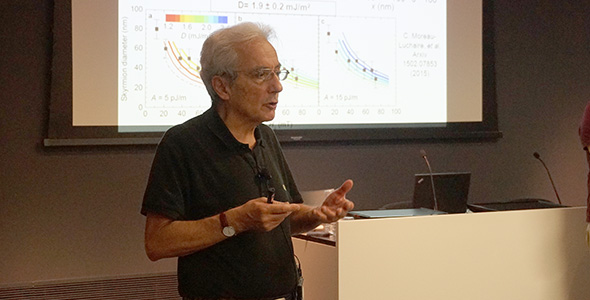
In November 2015 Prof Albert Fert visited ICN2. We had the opportunity to interview him and record his ICN2 Manuel Cardona Lecture entitled "Spin-orbitronics, a new direction for spintronics". Interacting with him is a gift for curious minds. Now you can watch on YouTube both his highly specialised talk and a relaxed interview. We hope you enjoy it!
Friday, 08 April 2016
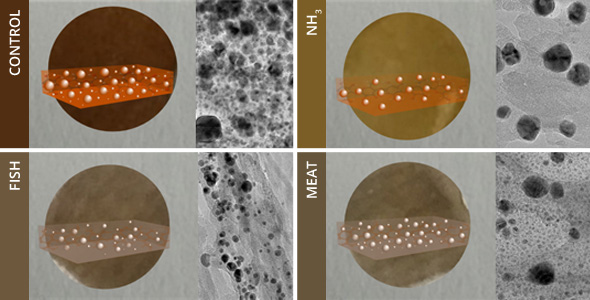
ICN2 researchers from Nanobioelectronics and Bisoensors Group, led by ICREA Professor Arben Merkoçi in collaboration with researchers in Canada and Iran, report a novel sensing technology for the visual detection of volatile compounds in a piece of plasmonic nanopaper. Their results have been just published in Nanoscale.
Thursday, 10 March 2016
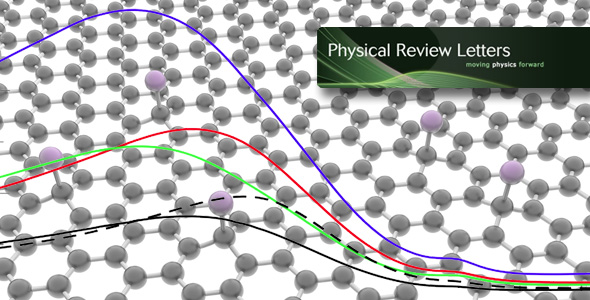
Spin manipulation is one of the most critical challenges to realize spin-based logic devices and spintronic circuits. ICN2 researchers Dinh Van Tuan and ICREA Research Professor Stephan Roche, from the Theoretical and Computational Nanoscience group reveal that certain impurities such as fluorine ad-atoms could result in a remarkable variability of spin transport characteristics in graphene, as published recently in Physical Review Letters.
Thursday, 03 March 2016
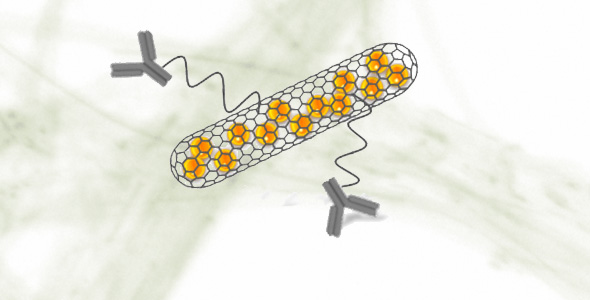
Researchers from the Materials Science Institute of Barcelona (ICMAB-CSIC) in collaboration with the Catalan Institute of Nanoscience and Nanotechnology (ICN2), the Institute of Molecular and Cellular Biology (IBMC-CNRS) and King’s College London (KCL) have developed a novel nanocarrier anti-cancer platform for the targeted delivery of radioactivity.
Friday, 26 February 2016
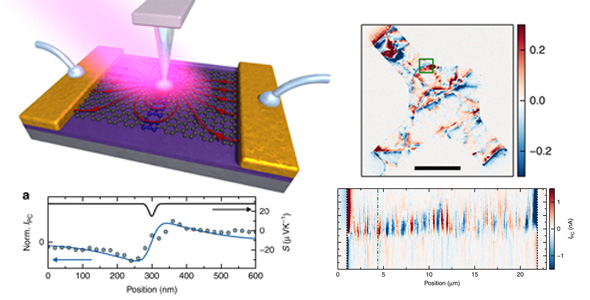
A recent paper in Nature Communications reports a simple and robust technology using non-invasive opto-electronic nanoscopy to probe locally both the optical and electronic properties of graphene devices. The work results from an international collaboration led by ICFO, with ICN2 participating to the theoretical interpretation of the experiments.
Tuesday, 23 February 2016
ICN2 researchers Aron W. Cummings and ICREA professor Stephan Roche, from the Theoretical and Computational Nanoscience group report new insights on spin lifetime in ballistic spin-orbit materials. Their results have just been published in Physical Review Letters.
Monday, 08 February 2016
Lluis Rovira, Director of the CERCA Institution, chaired the event that introduced the result of two years of diagnosis and discussion within the ICN2 Equal Opportunities Committee. The Plan presented on february first seeks to ensure that ICN2 offers equal opportunities for men and women and to promote the development of women in the scientific career.
Monday, 08 February 2016
An international collaboration presents in Nano Letters a platform for realizing new device and physics experiments with a strong interplay between electronic and spin degrees of freedom. The ICREA research Prof Jordi Arbiol, ICN2 Group Leader, is among its corresponding authors.
Friday, 05 February 2016
The ICN2 NanoBioelectronics and Biosensors Group, led by the ICREA Research Prof Arben Merkoçi, presents a versatile, low-cost and customizable method for patterning graphene oxide onto a myriad of substrates. The patented technique, published in ACS Nano, requires neither a clean room nor organic solvents. It consists of three easy steps: printing, filtering and pressing.
Thursday, 21 January 2016
Dr. Maurizia Palummo offered, on January 21, an ICN2 seminar about Transition metal dichalcogenides. She presented recent results obtained by her team and elucidated the time scale and microscopic origin of light emission in these two-dimensional systems. The speaker was invited by the ICN2 Theory and Simulation Group, led by Dr. Pablo Ordejón.
Tuesday, 22 December 2015
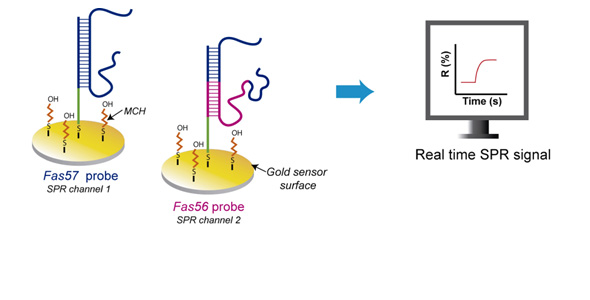
Deregulated alternative splicing patterns could be considered as a hallmark of cancer. A recent paper in Biosensors and Bioelectronics reports a simple and robust technology using a Surface Plasmon Resonance (SPR) biosensor for label-free monitoring of alternative splicing events in real-time. The work was led by the ICN2 Nanobiosensors and Bioanalytical Applications Group in collaboration with the CRG.
Friday, 27 November 2015
Coordinated by Dr. Belén Ballesteros, Division leader of the Electron Microscopy Division, and the ICN2 HR & Education Department, the Program was launched on November 26 with a Seminar devoted to “Basic concepts on electron microscopy”.
Wednesday, 25 November 2015
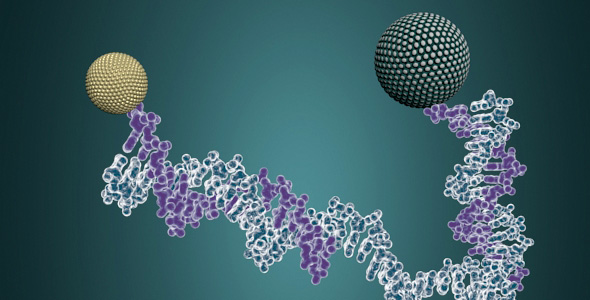
In an article published in Small, researchers successfully applied a new qualitative and quantitative method for the detection of a DNA sequence characteristic of Leishmania infantum kinetoplast, a frequent parasite in veterinary that affects humans too. The work was led from the Catalan Institute of Nanoscience and Nanotechnology (ICN2) and the Spin Off company Vetgenomics.
Monday, 23 November 2015
“Moore’s law” approaches its limit. The idea of producing the world’s first integrated flexoelectric microelectromechanical system (MEMS) on silicon was published week in Nature Nanotechnology and gained a big attention. The international work was led by researchers from the ICN2 Oxide Nanoelectronics Group.
Monday, 23 November 2015
Dr. Sander J. Wezenberg, from the Stratingh Institute for Chemistry, University of Groningen (The Netherlands), was invited by Dr. Jordi Fraxedas to offer an ICN2 Seminar entitled “Photochromic molecular switches and motors as tools for adaptive nanosystems”.
Thursday, 19 November 2015
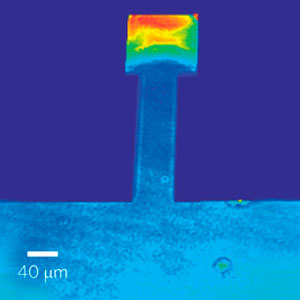
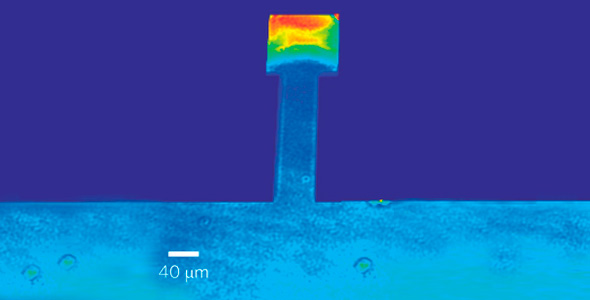
“Moore’s law”, according to which chip performance would double approximately every two years, approaches its limit: soon it would be impossible to produce smaller transistors. A new quest, nick-named “more than Moore”, aims to add new functionalities within each chip by integrating smart materials on top of their silicon base. Researchers from the ICN2 Oxide Nanoelectronics Group led an international collaboration which has produced the world’s first integrated flexoelectric microelectromechanical system (MEMS) on silicon. Their results have been published this week in Nature Nanotechnology.
Monday, 16 November 2015
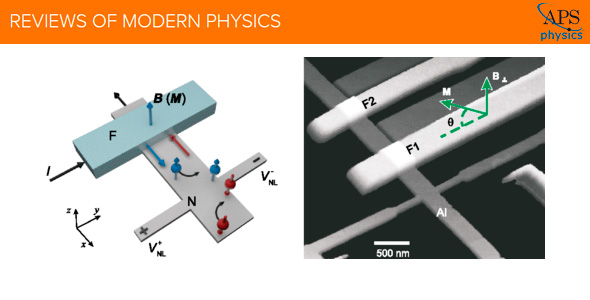
ICREA Prof Sergio O. Valenzuela, Group Leader at ICN2, is among the 5 authors of a review article highlighted on the cover of the journal Reviews of Modern Physics. The article offers a pedagogical overview of the Spin Hall effect, both from a theoretical and from an experimental perspective.
Friday, 13 November 2015
Prof. Rafal E. Dunin-Borkowski, Research Director of the Institute for Microstructure (Germany), presented a selection of recent results obtained in both high-resolution and Lorentz modes and offered a personal perspective on directions for the future development of transmission electron microscopy. ICREA Prof Jordi Arbiol, Group leader of the ICN2 Advanced Electron Nanoscopy Group, presented this influential speaker.
Friday, 13 November 2015
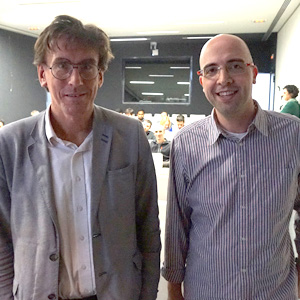
The Nobel Prize awardee and member of the ICN2 Scientific Advisory Board offered on November 11, 2015, a Manuel Cardona Lecture entitled “Spin-orbitronics, a new direction for spintronics”. Afterwards he participated in a tour through the ICN2 involving different Groups and a lively discussion during a friendly lunch.